
In large organizations and in legacy industries you’ll find these roles for business process analysts. A lot of admin work ultimately boils down from moving data from system A to system B and applying some transformation along the way. Is this just ETL? At a high level yes.
The Data Science bubble of the 2010s created a lot of folks that were too technical by half and can only Jupyter notebook their way to machine learning models that have a tough time delivering value. No worry, these folks are exactly the right people to pivot to business process automation/optimization to generate a ton of shareholder value.
Oftentimes these initiatives never get prioritized by organizations for a few reasons:
- Technical Skill Required (programming, requirements gathering “people skills”, deployment)
- Software Engineers are delicate geniuses and are only put towards revenue generating projects. They use their backlog as a shield to prevent them from doing stuff they don’t want to do. In the past, I’ve seen bounties for these projects work well as incentives for developers to knock them out.
- Cost reduction doesn’t get you to VP, cost reduction is an operations function generally and is not a priority if everything is up and to the right. Usually a executive function.
I have always been an advocate for these initiatives mostly due to my love for mean and lean teams. These types of projects are ideal for up and coming data analysts/operations analysts. People who are close to the action but have ambition to move into a more of a technical or management role.
For data practitioners, the highest ROI activity we can do for an org is automate one or a chain of administrative tasks. While analysis is fun and all you can really move the needle through scripting, data quality checks, and moving data around.
How does this work in Practice?
Understanding the Business problem/process.
Questions to consider when evaluating a process for automation: Are the inputs and outputs relatively predictable? Are systems A/B accessible to by a programmable asset? Is the juice worth the squeeze?
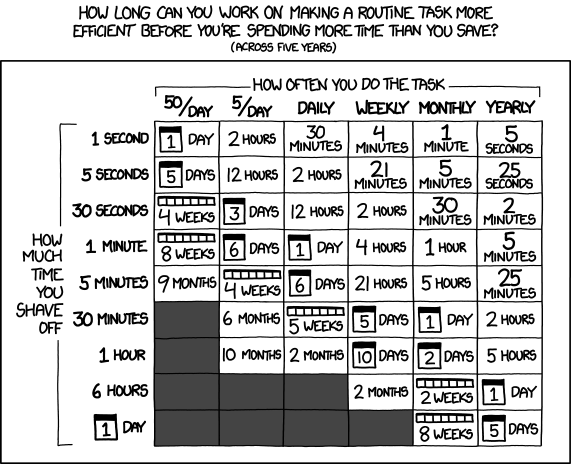
Meet with Stakeholders and understanding the process. People will never tell you what they need to have happen and can get uneasy around the notion of automating their work. This step requires some emotional intelligence as you need to meet them where they are. A talk track that I use which conveniently is also true: We’re going to automate this tedious task for you so you can work on higher value tasks that bring your experience and skills fully to bear.
Tools for the Job
Depending on your budget or IT configuration will limit what tooling you use for this. If you aren’t technical (and don’t want to be) you can use Zapier, which will work in 85% of cases. However, if you have aspirations of becoming technical or are budget constrained, using code based tooling is the way to go.
Everyone has run into a wizard in the IT org that built systems of VBA with Microsoft office tools that add a ton of value to the business. You’ll still encounter a lot of VBA here and there. But they haven’t made any updates to it since 2008 and Microsoft has blessed us with the Power Platform. Which is basically Zapier within the Microsoft Ecosystem.
Google has App Scripts and is an extension of Google Cloud. If you’re on the GSuite for work you’re leaving a lot of productivity on the table by not looking into this. As someone that is always looking for cost effective solutions, I like app scripts because it’s free to start and takes a lot of the headache away from managing your environment + uses JavaScript syntax which is quite easy to get rolling with LLMs.
Another option is to use Python or another scripting language to do these tasks. I have done this all the time in every role I’ve had since finishing college. Depending on the job you can run it on your local machine, deploy to some serverless function, or dockerize your script and deploy to a cloud service or some other asset. This last piece is important if you wanna get into Data Engineering. This devops piece was the trickiest bit of skill acquisition in my experience coming from a business user first.
Large Language Models
We’ve had Large Language Models for long enough now to know what they are good for and what they aren’t. Boilerplate, well defined tasks that use established languages or libraries are ideal. Business process automation is a target rich environment for LLMs to ship faster. I’m at least 50% faster banging out a quick automation with Copilot in another tab. The risk/reward for these types of projects out of nowhere got a lot juicier. There is so much low hanging fruit out there and with these inflationary cost pressures it’s never been a better time` to get some points on the board with some “Automated this process which saved x hours ($1000s dollars annually)” projects.
Google App Scripts Demo

Sending template communications is a pretty common business function and I wanted to try out multiple services. I have a spreadsheet template where the rows are for one step in the process. Then I have a template document where the variables corresponds to rows on the spreadsheet like {Customer Name}.
Development Process
Normally something like this would probably take me a few hours. That is an aggressive argument considering I do not know JavaScript.
Found this Demo . Put it in VSCode. Had Copilot adjust the code to fit my requirements. Ran some tests, noticed the PDFfile was blank, asked copilot a few times and researched the docs. Turns out the code runs asynchronously and I needed to add a line to close the file before exporting to PDF. Everything worked.
Total Time: 30mins
Link to Code
Google App Scripts also supports scheduling jobs, deploying jobs as endpoints (I used this functionality in this project). Overall a very smooth experience and helps ship quickly and deliver value.

 He Was A Data Boi