I was introduced to Lu Xun’s short stories (can be found here) during a Chinese history course I took in College. The writing is clean, thought provoking, and presents Chinese History during the Revolutionary period (1910-1930) with an emotional twist. He was one of the leading intellectuals who were educated abroad and then tried to use what they learned to build a better China. His stories center around an individual or small group and shows an depressing aspect of Chinese life up close and personal. When analyzing these stories in aggregate, a picture emerges that building a better China would require massive societal changes and wasn’t going to happen with high minded rhetoric alone.

The Qing Dynasty collapsed or “lost the Mandate of Heaven” for a host of reasons that I’m not going to get into. One of their last attempts at bureaucratic reform was to abolish the kējǔ or Imperial Civil Service Examination. These exams had been in place for centuries and was the primary means of staffing the Imperial bureaucracy. Sidebar: Many people view this system as a great meritocratic equalizer. This insight ignores the realty that being literate and resources for tutoring/studying was required making it a privilege of the wealthy (sounds familiar). Classical Chinese studies and Confucianism were heavily emphasized and prospective test takers were expected to have deep knowledge on these subjects. As it turned out the opportunity cost of learning all this esoteric material greatly exceeded its productive use. Sounds familiar doesn’t it?
Lu Xun’s Kung I-Chi centers around one of these scholars who overnight was made useless and ends up as a drunk. Kung I-chi having the robes of a Scholar has notional status above the laborers that he shares the bar with. This doesn’t matter though when you cant pay for drinks. He becomes the butt of the jokes for the others at the bar and he knowledge on the Confucian texts primary utility is for fun facts.

You probably know a Kung I-chi in your life. A “gifted kid” that never amounted to much (and still mentions it), a liberal arts major who is underemployed, and/or a recent graduate who has significant student debt.
Education reform has been in the zietgeist recently due to the potential for a new administration that may forgive federally owed student debt. While writing that debt off would provide relief to young people and act as a targeted fiscal stimulus to them. We are still left with people that don’t have skills necessary to meet the demands of the economy. Any education reform where educational institutions don’t change their process to create more productive graduates. Will create another cohort of graduates who end up missing out on life.
“Education” is one of the most celebrated memes in America. What education represents in our minds (and in the marketing material) is the opportunity to deeply explore a subject, develop skills, make friends, and “find yourself.”
I’m not going to do a deep dive on education reform. That’s not really my thing. The best thing I’ve ever read on Education Reform is from Rusty Guinn at Epsilon Theory.
Skill Gap
Opportunity cost is one of the main selling points of the University experience. For both the social experience and future expected earnings. High school students are presented with a choice: miss out on all the fun and the money or go to school and figure it out later. As someone in my mid-twenties, it is clear to me know that we were presented with a false trade-off and a lot of kids got played.

Paying for education with debt wouldn’t be a problem if the marginal income gain from the education exceeded the interest cost. The fact that partial degrees aren’t really worth anything would suggest that degrees are table stakes. If you don’t have one you wont even get a shot at interviewing for most of these positions. As anyone besides the official CPI will tell you, the cost of living for a young person makes breaking-even challenging and saving extremely difficult.

Why am I talking about the cost of living as relating to the skills gap you might ask? I believe to be partially related. While the rate of technological improvement hasn’t been as transformative of the 20th century, the software and computing improvements since 2000 presents an opportunity to increase young people’s wages and increase overall productivity.
The solution in my eyes is for higher education to stop treating their students as ATM machines and instead to focus on creating graduates that have no problem earning enough to justify the educational cost. People will say that the university system was never designed to do that. Fair enough, I don’t see why the system cant be reformed to produce graduates (bachelors) who aren’t pseudo-experts but instead people that have learned how to learn.
Diversification
I studied Finance in undergrad, of the required courses for the degree only 1/3 of them were specifically finance classes. General education classes (50% of the degree), were basically repetition of the same routine: readings, homework, write some half-assed essay, and a presentation or two. Development of these soft skills is important but diversification only works if what you’re doing is different. Writing a half-assed essay is a half-assed essay.
The process of writing half-assed essays in the passive voice that no one is ever going to read is superb training to become an email-sending pixel-pushing bureaucrat.

As far as I can tell the way these degrees are structured intends to teach students how to synthesize information and communicate professionally with their academic discipline as the vehicle. From there they are supposed to make connections to other disciplines to fill the gaps in their critical thinking process and challenge them outside of their comfort zone. Educational institutions have lost sight of this fundamental goal and have filled degree programs with courses that aren’t rigorous and diversifiers that are more of the same.
To put it in terms that may be easier to understand: a tortilla chip is means of sauce consumption. That’s all it needs to do. The Tostitos scoop is perfect chip in this regard. Load bearing to handle dips of different viscosity, No additional flavor added to distract from the dip, and ergonomically shaped to facilitate optimal dip collection.

Productivity
Everyone wants to work in tech but no one wants to be technical. Leave all the generalist coursework for the MBA’s. There is no reason why business and liberal arts students can’t get spun up on how to be a member of an organization and how to use the Microsoft suite in 6 months. After that they can get a job and supplement their professional development with part time courses on the nights/weekends. This decreases the opportunity cost, financial cost of school, and throws young people into the workforce when they have the most energy and will put some money in their pocket.
From 1960 to 2000, there was a reduction of the number of rail cars in America by 90%. Similarly the amount of cardboard used from 1990 to 2020 saw a reduction of 90% [look up exact numbers]. While operational processes aren’t as sexy as the development of Hardware. The time and resource savings have brought major booms to human prosperity. In addition, if we are to tackle climate change/pollution in a positive growth manner we are going to have to improve our processes and materials technology.
I have wrote a few times about the inverted demographic situation in the Developed world. Where the population is graying and more and more people drop out of the workforce. Our societies are structured to have a growing younger population whose productivity creates a surplus of capital that finances older folks later years. Technological advancements (and debt) have been able to keep overall productivity growth to compensate for the demographic drag.
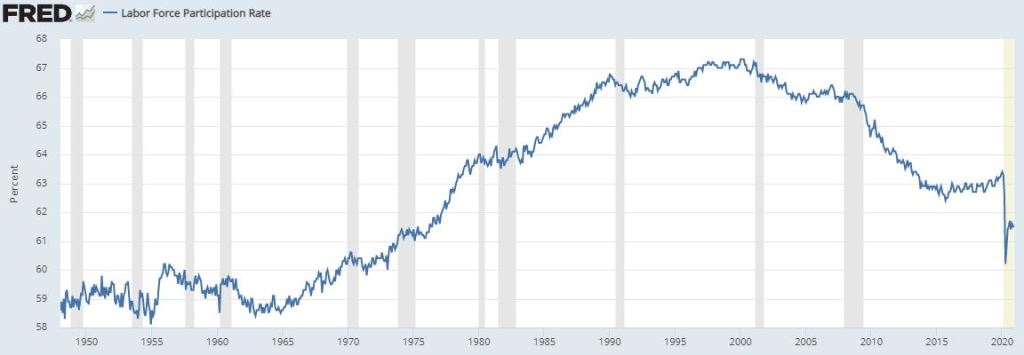
This demographic pressure will put a drag on societal productivity and cause pension and retirement systems to break. The unrest and revolutionary fervor this would lead to would not be fun. We have one shot at sustainable industrial civilization and if we don’t innovate our way with superior processes and technology then we might as well go the way of Kung I-Chi and take a drink.

 He Was A Data Boi